Mother’s Day Gift Guide: The Perfect Xero Shoes For Every Woman in Your Life


latest News

Barefoot in Asia - Regev's Review
I just realized that I have a strange history with barefoot running, barefoot walking, and minimalist shoes.First, like most of us, I spent a lot of time barefoot as a kid in the Summer. I went to a camp in the Pocono Mountains (Camp Shohola just in case any readers also went there) and whenever I had the chance, I was barefoot (made easier by the fact that I spent half of my days doing water sports). I was a competitive diver, too, so that kept me out of shoes.In junior high school and high school, I was a gymnast, so that was even more barefoot time every day.When I was 18, I went to New York City to be a street performer. I had already been doing this in Washington, DC, doing a magic act in Georgetown, and on K Street, near the White House. When I got to NYC, though, I found it much harder to get a crowd and, even worse, within a few weeks, the other street magicians had stolen all my bits! I asked one of the veteran street acts what I should do and he said, "Simple, write an act that nobody would dare steal."I pondered this for a while, until I landed on the answer. I created an act that had a bunch of crazy gymnastics in it (I did a running front flip over someone's head, stealing their hat and placing it on my head while in mid-flip), and a finale where I... wait for it... walked on broken glass in my bare feet.Now let me back up. For the gymnastics part of the act, I wore minimalist shoes. They were some old Adidas (I can't remember the name), with zero-drop, very little toe spring, not much padding. Just enough between me and the ground so I didn't kill my feet. This was in 1980-81, BTW.I loved these shoes. I bought every pair I could find. When I could no longer find them, I asked the local running shoe store what happened and he answered, "Adidas stopped selling them; they were lasting too long."I don't know if his info was accurate but, if it was, it wouldn't be the first time a company pulled a product that didn't wear out or go obsolete fast enough.Luckily, I found a company that sold shoes to prisons (you can find ANYTHING in NYC), and they had the last few pairs of these shoes... I bought them all. And they lasted through some serious abuse.Okay, back to walking barefoot on glass, though. Let's just say that it's part physics, part showmanship, and part some-hard-to-describe-thing that, if I could convince you to jump onto a 3" high pile of shattered beer bottles, you would instantly get a knowing look in your eye and say, "Ahhh... I get it now."In 5 years and thousands of shows, I only got one small cut. But by the end of the day, my feet were FILTHY from being barefoot on the street.CUT TO: Going to Asia in 1989.This is where I got hooked on being barefoot. Aside from the fact that you never wear shoes into almost any building (I was in China, Nepal, India and Thailand), there were plenty of opportunities to be barefoot outside as well. There were also plenty of times where you wanted something on your feet, but not much because it was really hot when I was there, and anything more than a sandal was way too much.When I came back from Asia, I stuck with the habit of removing my shoes whenever I went into someone's home (we've saved a fortune on carpet cleaning by not dragging dirt in from the outside).Okay, so why this long story?Simple, I was reminded of it all when Regev Elya did his review of Xero Shoes, which he took on a 7-month trip through Southeast Asia (I'm SO jealous).Of course, I think that Xero Shoes are the best minimalist shoes for a trip like that... but check out what Regev says.
Sh*t Runners Say to Barefoot Runners
Okay, barefoot runners, friends of barefoot runners, people who think running barefoot is silly, and anyone else who has ever seen, heard of, made fun of, or been married to someone who maybe heard of running barefoot or saw a picture of some Vibram FiveFingers (in other words: Hi, everyone!)...Here's the follow-up to the viral Sh*t Barefoot Runners Say (over 170,000 views as I write this).Inspired by, well, all the things I've heard runners say as I trotted about town without my shoes, or in my huaraches running sandals, it's Sh*t Runners Say To Barefoot RunnersShare this on FB, Tweet it, email about it, +1 it... let's make this one even more successful than the original!Aaarrrrrrrhhhh!
Barefoot Sandals - the best minimalist running shoes
Every now and then, someone will smugly say to me:"Barefoot Sandals is an oxymoron. If you're barefoot, you're not wearing sandals, and if you're wearing sandals, you're not barefoot!"Yes, technically, that's true. Barefoot is barefoot and shod is shod.And, I'll admit, I'm normally a stickler for grammar. I hate when people say "very unique" (something can't be VERY one-of-a-kind), and don't even get me started on "a whole nother" ("nother" isn't a word! You mean "another whole").But for "barefoot sandals" or barefoot shoes or even bare feet shoes, I'm willing to be a bit more lax, and not just because I'm in the business of making huarache sandals.It's simpler than that.In this case, there's not really much lost when you remove the "implied word": -style.That is, what people would say instead of "barefoot sandals" if they were being more accurate is "barefoot-style sandals," or "barefoot-style shoes," the implication being that this type of footwear is similar in some way to being barefoot.Now the key element to that sentence is "similar in some way," and I'm sure I don't need to tell you that many shoes that advertise themselves as barefoot running shoes are about as similar to barefoot as a pair of stilts (I should make a spoof commercial about barefoot stilts!).Some manufacturers say that their shoes let your foot move as if you're barefoot, or run with natural form (usually meaning forefoot or midfoot striking). Others say that you can feel the ground as if you're barefoot.It won't come as any surprise that I think Xero Shoes does this better than any other product. After all, what could let your foot move more naturally than having nothing on your foot? And what could give you more ground-feel than just a bit of rubber (oh, I know, LESS rubber... but that's a story for another post).One of the first Xero Shoes customers said it best when he came back from his first run, all giddy, "It's just like being barefoot... if they covered the earth in 4mm of rubber!"So, cut some slack to those of us who use phrases like "barefoot sandals" or "barefoot shoes." Let the implied meaning come through. But do demand that those who use the phrase can back it up with a product that lives up to the claim.
How To Run Barefoot
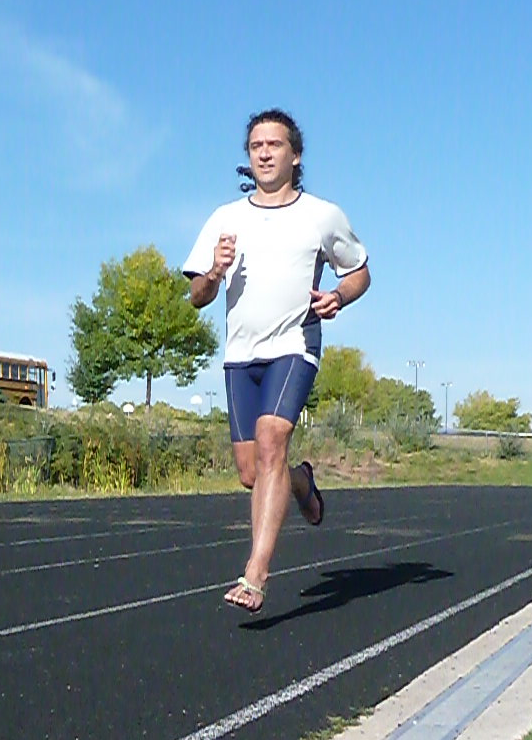
How to Run Barefoot: Techniques to Get Started “How do I start barefoot running?” “What’s the best book/course/coach for learning to run barefoot?” “Can you show me what the best barefoot running form looks like?” I get these questions a lot. And it’s a bit tricky to answer them for a few reasons: Frankly, if all you did was take off your shoes, go for a run, stop when it hurts, and experiment to find ways of running that feel light, easy and fun (which is the way running with natural form should feel), you would learn more than I, or anyone else, could tell you. Those of us who’ve observed barefoot runners and coached barefoot running are starting to notice the obvious: different runners have slightly different form. That is, when you look at the BEST runners, they have many things in common, but they’re not all doing the exact same thing. So, I don’t want to say something that isn’t going to be relevant for YOU. To be totally candid, I’m in an awkward political situation — as a guy who sells “barefoot-style” footwear, and who would like to have ALL the coaches referring their clients to me, I can’t single out one coach/book/technique over another (or one “under” another, either). I can tell you that if you listen to ALL of them, and then follow a bit of advice I’ll give, below, you’ll appreciate each coach for his/her unique contribution to your barefoot running form. Many runners aren’t aware of what their bodies are actually doing, so certain recommendations won’t be effective anyway. If I say to you, “don’t land on your heels,” and show you a video of how you’re “supposed” to land on your foot, you may be 100% convinced that you’re doing what I suggested, and then a video might show that you are totally heel-striking. In other words, what I say will be less important than what you learn on your own. However, what I CAN do is offer some thoughts about getting started with barefoot running. Tips on How to Run Barefoot Here are my best tips on how to get started running barefoot, refining your running technique, and enjoying the benefits and fun of barefoot running How to Getting Started Realize that the best coach you have is YOU and your sensations and whatever you can learn from watching video of yourself (especially slow motion video). In fact, you MUST become your own best coach, because no external coach will be there for every situation you’ll encounter as a runner. If you can’t listen to yourself, make adjustments in what you’re doing, and know when to STOP… no other coach will be helpful anyway. Start SLOWLY and build up. There’s no rush in making the transition to barefoot running. And there’s no way to predict how long it will take YOU. Run barefoot on a hard, smooth surface. These surfaces are best for learning because they give you the most feedback. Remember that barefoot running is a never-ending process. You can always improve. Refining Your Barefoot Running Form To be slightly more specific and technical, and tell you some of what you would discover on your own with enough time and attention: Aim for having your feet land “under your body” - more so than you’re probably used to. Landing with your foot out in front of you too much is “overstriding” and it’s one of the habits that most of us need to work to overcome. You may need to even exaggerate this to get the feel of it — put your feet “behind you” when you land. You won’t actually be able to do this, but if you try it will highlight what overstriding feels like… and the correct place to put your feet is probably somewhere in between. You want to land forefoot or midfoot. Do NOT reach out with your foot to do this; that’s the opposite of what you want to do. By the way, If you land with your foot underneath your body it's almost impossible not to land on your forefoot or midfoot. You don’t need to stay on the balls of your feet and put extra strain on your calves and Achilles tendons. Once you land on the ball/midfoot, you can let your heel drop if it feels better to do that, and it will feel better/worse depending on whether you’re going uphill or downhill or on a flat surface, and depending on what speed you’re running. Don’t PULL your foot toward you, or PUSH it behind you… that’ll cause blisters as well as put extra strain on your hamstrings (pulling) and calves (pushing). Think, instead, about PLACING your foot on the ground and LIFTING it off. And lift by using your hip flexor. That is, think about lifting your foot off the ground by lifting up your knee, not by pushing off the ground. Un-Plop your feet. This is hard to describe, but many of us slam our feet into the ground, or wait for the ground to hit our feet. We plop them onto the ground instead of meeting the ground lightly. There are a lot of “cues” coaches use to teach this: Pretend you’re running on hot coals, or on thin ice, or trying to sneak up on a deer, or that your feet are wheels and you want them to touch where the wheel meets the ground, or that the ground is moving below you like a treadmill and you want to move your feet at the same speed as the treadmill. You will need to find your own way to feel this. Keep your core tight… when you run, your body is a spring. If you collapse in your midsection, you’re weakening the spring and making it less efficient and, therefore, making it harder to run. Pick up your cadence. Most people think 180 steps-per-minute is some magic number. It’s not. Some successful runners do more, some do less. The point of moving your feet faster than you’re probably used to is that it gives you less time to keep your feet on the ground… and that’ll help you learn to place/lift, “un-plop” and not overstride. LISTEN to the sound your feet are making… if you’re running loudly, if you make a lot of noise when your feet hit the ground, you’re doing one of the above incorrectly. This is true if you’re barefoot, in our barefoot shoes, or any other footwear. You can run quietly (not silently), and quiet running is usually a sign of good form. WONDER! When I run, I keep a question in my mind, “How can I make this lighter, easier, and more fun… and, sometimes, faster?” Then, I experiment and see what I can find. Finally, and most importantly: REST. Bodies get stronger when you let them rest. There are no bonus points for not taking a day off. HAVE FUN! If it’s not fun, do something different. Try a different surface, a different speed, a different reason for running (compete if you haven’t before, do an obstacle course if you’re usually all about putting in mile after mile). I’m sure other barefoot runners have additional pointers. Can’t wait to hear them. Oh, and did I mention, barefoot running can be, should be, and IS (once you get it) FUN… don’t forget that! Want to learn more about learning how to barefoot running? Watch this video below The content of this post does not constitute and is not intended to be a substitute for professional medical advice, diagnosis or treatment. Always seek the advice of a physician or other qualified health provider with any questions or concerns you may have about your health or a medical condition.
Sh*t Barefoot Runners Say...
You're not a real barefoot runner if you haven't said one of these ;-)
Harvard Barefoot Running Studies Support Xero Shoes
What are the benefits of barefoot running? Well, Harvard's Dr. Daniel Lieberman has another answer. His studies from 2 years ago showed how barefoot runners who forefoot strike put less force into the ground and, therefore, less force into their joints. Now he has 2 new studies that have just come out that support how proper barefoot running form and minimalist running shoes can result in fewer injuries and more efficient running. "Foot Strike and Injury Rates in Endurance Runners: a retrospective study" looked at college cross-country runners and found that those who heel-strike (landing on their heels first) had approximately twice the rate of injury than those who forefoot strike. For those of you who've been exploring barefoot running know, proper barefoot form involves landing on the forefoot first. BTW, that doesn't mean you "run on your toes" -- your heel can naturally drop to the ground after the forefoot meets the ground first. In fact, letting your ankle relax is part of the natural spring mechanism of the leg. You may also know that the easiest way to help train yourself to forefoot strike is to go barefoot or wear something genuinely minimalist, like Xero Shoes. The more you can feel the ground when you run, the less you'll want to land on your heel... because IT HURTS! Be careful, though, many shoes that call themselves "minimalist" still have enough padding and protection between you and the ground that you lose the barefoot feel and can still heel strike. In fact a recent barefoot running study by ACE and some video of barefoot runners made by Pete Larson of runblogger.com showed that a majority of Vibram Fivefinger wearers still heel strike as they run. In my experience, this is probably because the VFFs have enough padding (especially the ones made for running, ironically) that the wearers can't tell they're still heel striking. Dr. Lieberman's other study, "Effects of Footwear and Strike Type on Running Economy" demonstrated that runners in minimal footwear have increased efficiency than those in traditional running shoes. Specifically, the study concluded that "Minimally shod runners are modestly but significantly more economical than traditionally shod runners regardless of strike type, after controlling for shoe mass and stride frequency. The likely cause of this difference is more elastic energy storage and release in the lower extremity during minimal shoe running." If minimal shoes make you more efficient, that's good news for us, since Xero Shoes are about the most minimalist running shoe you can find. :-)
4 Reasons NOT to Run Barefoot
[This post is guest-authored by our friend Rob Raux from www.shodless.com]Being barefoot and running barefoot is a blissful and consciousness-expanding endeavor. The feedback supplied from the ground is powerful enough to force even experienced runners to try it for only a mile or so, if they make it that far. Barefoot running, however wonderful, should not be subscribed to dogmatically.There are myriad resources available expounding on the benefits of being barefoot. Most of their reasons, methods, and warnings have merit. Unfortunately many of them sway to heavily towards the one-size-fits-all solution.Experiencing life unshod isn’t always the best option. Putting on a pair of huaraches or other minimalist shoes can serve a number of beneficial purposes: Technical Trail Running. Many people worry that the rocks, twigs, and roots on a trail make barefoot trail running impossible. Not true. First, you use your eyes and avoid what worries you. Second, your feet aren't rigid and can grab and grip and mold around many "obstacles."That said, while there’s nothing better than feeling the grass beneath your feet, having your heel land on an embedded rock leaves something to be desired. To be more specific, it could leave behind a bruise that will take at least a week to heal.That doesn’t include the chance of damaging the fatty tissue which protects your heel bone from impacting the ground. If any of this sounds painful, trust me, it’s worse than you’re picturing.A trail has hazards which you may not wish to risk if you're still an inexperienced barefooter. When a single false step means a week of no running, it’s just not worth it to be ideological about keeping yourself unshod. Additional mileage Your body may be able to take additional mileage, but the bottoms of your feet may not be ready to support it yet barefoot. Now, if you're looking to become a better barefoot runner, this is good news -- when your skin tells you to stop... STOP! Over time it'll adapt (not callous) and you'll be able to put in more miles.Until then, there’s nothing wrong with protecting your precious footsies, but only if you know your form is correct. If you are transitioning from shoes to barefoot and have yet to perfect the change from heel strike to mid foot strike or a forefoot strike, don’t ask for trouble by adding more miles in a minimalist shoe. You’ll find yourself injured promptly and thoroughly.If you are comfortable in your stride, you will find that your feet hit a natural point where further barefoot running may only lead to blisters (that usually means your form has broken down and you're pulling/pushing the ground, instead of placing/lifting). In these cases, adding a protective covering will give you the opportunity to add those additional miles you crave. Racing A foot covering increases your margin for error while running. Proponents of barefoot running tout the pain feedback loop as a beneficial aspect. Any foot covering blocks the pain receptors, which allow you to cause more damage to your body.In a race, this can be a necessary evil. A reduced pain feedback loop allows you to run a longer duration of more intensity. The covering may also absorb some of the mistakes you may have made barefoot (stepping on that rock in your mental fatigue).There’s obviously a very fine line to be ridden here, and one that you can certainly go too far with. Go with the least amount of covering possible and you should be able to dampen and absorb just the minimal amount of error to improve your results.I'd love to say, "If you're not comfortable running that distance, don't race that distance." But I know how some of us... I mean, YOU... can be ;-) The bitter cold Mother nature yields to no man. Don’t even think about getting the best of father winter.If you live in a climate that has a true winter, you know what frostbite feels like. Now try running barefoot.Amazingly, there are folks who do it, and enjoy it. And check out Steven shoveling snow in his huaraches. Frankly, I’ve tried it and even I think that’s crazy. Most people are going to need something to keep their feet protected from the elements (wind, snow, slush, etc.). Each person has a different tolerance, which will adapt as they get more comfortable with the colder weather.When dealing with the elements it’s best to be safer than pull up limp 3 miles from your house and walk the rest of the way home. The content of this post does not constitute and is not intended to be a substitute for professional medical advice, diagnosis or treatment. Always seek the advice of a physician or other qualified health provider with any questions or concerns you may have about your health or a medical condition.

Barefoot in the Cold
Here in the Northern Hemisphere, Winter is upon us. And people email me every day asking what to do if they want to be barefoot or minimalist in the cold weather. While I've written about running barefoot in the cold before, this is a whole new thing ;-)First let me say: DO NOT TRY THIS AT HOME. In other words, don't go out and try to imitate me.I've been barefoot running for over 2 and a half years, and haven't worn a pair of real shoes for more than a total of 3 days in that time.Last winter, I thought, "I'll keep my barefoot shoes on until it seems too cold." And the next thing I knew, it was Spring!So, clearly I've acclimated. And that's not too surprising. Humans (and our hominid cousins) lived in cold climates without shoes for a LOOOONG time. So, we're kinda wired for it, if we give ourselves time to adapt.Here's the video I just shot, after we got 18"+ of snow in Boulder. It's about 15 degrees out.What I did is this: Outside for about 10 minutes Inside to dry off my feet and warm them for 5 Outside for another 10 Inside to dry and warm for about 3 Outside for 30+ minutes... by this time my body temp had gone way up. I was sweating quite a bit. And my feet felt totally warm. Not numb. Warm. When I got inside after finishing the shoveling, they didn't have to thaw or warm up or anything. Lena wants me point out that you should check the Wiki about frostbite so you don't do something stupid and get hurt ;-)The content of this post does not constitute and is not intended to be a substitute for professional medical advice, diagnosis or treatment. Always seek the advice of a physician or other qualified health provider with any questions or concerns you may have about your health or a medical condition.
Bare feet are not just for running
If you thought being barefoot was just about running... HA!And if you worry about things you might step on... HA! HA!
Barefoot Running Sandals vs. Running Shoes
A barefoot running vs. running shoes "infographic" I'm get all geeky over well-presented information, and the graphic about barefoot running and regular running shoes from XRayTechnicianSchoools.net is a pleasure. Whenever someone says to me "Barefoot running can cause injuries" I remind them of the fact in 1/3 of the infographic: 90% (I heard 80%) of marathoners get injured each year. When people ask me about wearing barefoot running shoes in the winter, I remind them of that big squiggly time line showing that for hundreds of thousands of years, we would walk and run barefoot, without shoes, in some pretty cold places (in other words, your body, given time, will acclimate). And, I agree that being barefoot is not appropriate all the time... like when you want to get into a restaurant. Hence the value of our high-tech upgrade on the Tarahumara huarache-inspired shoes and sandals, where you still get a great barefoot feel, but can get into restaurants. I also got a great flashback from the 1974 timeline: I vividly remember getting my first pair of Nike Waffle Trainers. What's funny is that most people remember that it allowed you to land on your heel. I remember that it had such a large amount of "toe spring" (a curve up from the ball of your foot to your toes) that it kept me on my toes! (I was, and still am, a sprinter, so I don't spend much time running on my heels). AMAZING to see that barefoot running shoes are a $1.7 billion industry, in part because the market has grown MUCH faster than anyone imagined it would. But also because most of the barefoot running shoes are SO expensive. Minimalist shoes clearly doesn't mean minimalist prices, it seems ;-) And, of course, I agree about the best way to start barefoot running (there's no rush to make the transition out of running shoes and over to barefoot) Created by: X Ray Technician Schools The content of this post does not constitute and is not intended to be a substitute for professional medical advice, diagnosis or treatment. Always seek the advice of a physician or other qualified health provider with any questions or concerns you may have about your health or a medical condition.
The little lie of barefoot running
As the barefoot running boom continues to explode, it’s important that we debunk the mythology that’s sprung up and face some facts. And perhaps the most obvious fact is this: If you run with anything between your skin and the ground, you are not barefoot runner. Let me say that again. If you wear Vibram Fivefingers, New Balance Minimus, Merrell Trail Gloves, Altra Adams, Vivobarefoot shoes, Newtons, Inov8 shoes, even our Invisible Shoes huaraches running sandals, you are not a barefoot runner. I don’t care if your previous shoes were padded stilts and your new shoes are a “zero-drop” natural movement minimalist shoe, if you’ve got something on your feet you’re not barefoot running. Barefoot running means that you run in bare feet. Period. Now, don’t get me wrong, I’m not saying that if you’ve just spent $125 on your Vibram Bikilas you need to throw them away, or that if there’s a barefoot running Meetup you can’t be part of the cool clique. And I’m not saying everyone needs to be barefoot. And, clearly, I'm not saying "don't buy Xero Shoes" ;-) But it’s important that we differentiate actual barefoot running from minimalist running. Why? Because more often than some would like to admit, barefoot running and minimalist running do not produce the same results. The promise of barefoot running is that the sensations you get when your skin contacts the ground — often known as pain — teach you proper running form. That is, if you change your form to make the pain go away, you’ll have a more efficient, lighter, easier stride, and you’ll be able to run pain-free for life. Anything that you put on your feet reduces the amount of sensation you feel and can interfere with the feedback loop that barefoot running gives which produces those benefits. Again, I’m not saying that you don’t get feedback from minimalist shoes. You certainly get more than you do when you’ve got 2″ of padding in your Nike I Can’t Feel The Grounds. As the developer of Xero Shoes, I know hundreds of people who switched to our sandals, improved their barefoot running form, eliminated life-long aches and pains, and now enjoy running ultra-marathons. As one of our early customers put it, "Xero Shoes are just like being barefoot... if they covered the world in a thin layer of comfortable rubber." But, I’ve also met a LOT people who bought a pair of Vibrams or Merrells (or any other minimalist shoe), soon became injured, and now tell everyone they know that “barefoot running” is dangerous… and they’ve never run barefoot! I’ve been on a number of barefoot running panel discussions and, inevitably, there will be some number of doctors, physical therapists, podiatrists and other medical professionals who say, smugly, “Hey, stick with this barefoot running thing. All the people getting hurt by doing it are putting my kids through college!” Before they can finish chuckling, I fire back: Me: “You know, of course, that all you guys made the exact same joke 40 years ago when running shoes were invented, right? And you know that people who have no problems running barefoot — and ones who get cured of injuries by running barefoot — will not come to see you, right?” Them: “Uh…” Then I pull out the bigger guns: “And when a patient tells you they got hurt from barefoot running, did you ask if they were actually in bare feet? Did you check to see if they simply over-trained by doing too much, too soon? And, maybe most importantly, did you take a video of them running so you could analyze their form and see if they were simply using the same injury-producing mechanics they used when they wore shoes? Or did you see if they were trying to stay on their toes, putting extra strain on their calves and Achilles, because they have a mistaken ideas about proper barefoot form?” Them: “Uh…” Barefoot running is more than switching to a minimalist shoe. And it’s more than simply removing your shoes. Don’t believe me? Go to a barefoot running event, find the people in their minimalist shoes, and see which ones are still landing on their heels, as if they’re still in motion controlled running shoes. In fact, be on the lookout for runners who are actually barefoot doing the same thing! Some of us are either unable to feel those important form-changing sensations, or unable (without coaching) to actually make form changes in order to find a painless way of moving. For an example of this, check out Pete Larson's video of the recent NYC Barefoot Run. Most of the VFF wearers, and a handful of barefoot runners are still landing on their heels. (I was there and noticed the same thing, but I didn't have the brains to video tape it... so, Thanks, Pete!) Let’s wrap this up with a wish: If you’re one of those “barefoot” runners who has never run barefoot, I can’t encourage you enough to try it. Don’t think there’s some transition you need to go through before you’re “ready.” Ironically, the best advice I can give you is: Just Do It! Get on a good clean hard surface (a bike path is great, streets work too) and go for a run. Listen to your feet, if they hurt, try to move in some different way so that they don’t. And if you can’t figure out how, then stop and try again another day. Don’t think you need to build up callouses; none of us who successfully run barefoot have any (they’re another sign that you’re doing something wrong). If you can find a coach or some training, get some guidance. Report back here with what you discover. The goal is not to be barefoot all the time. The goal is to be flexible. To be able to run comfortably, easily, and enjoyably under any circumstance. To know when barefoot is the best option and when something under your feet is called for. I wear my Xero Shoes for all my walking, hiking, and getting into restaurants. I'm barefoot for a lot of my sprinting training. But, hey, I still wear running shoes, too… when I have to shovel a 2′ Colorado snowfall. The content of this post does not constitute and is not intended to be a substitute for professional medical advice, diagnosis or treatment. Always seek the advice of a physician or other qualified health provider with any questions or concerns you may have about your health or a medical condition.
5 Common Stride Missteps
Let us guess, you ditched the cushioned clodhoppers only to find a new host of issues to deal with. Blisters on the bottom of your feet? Sore hips? Calves aching so much you can’t walk? Soak in some Epsom Salt and give yourself a break. No one said changing a lifetime of running habits overnight would be easy. No matter what shoe (or lack thereof) you wear, if you don’t change your stride, it won’t matter. Not sure if you’re “doing it right?” Below are five common missteps to set your stride straight.Misstep #1 Incorrect Stride RateWhen it comes to running, we get into a groove and find a familiar, comfortable place. We expect things to feel a certain way. Traditionally, runners trod along at roughly 120 steps per minute. With a forefoot or mid-foot stride, you need to speed up your stride rate and shorten your steps to roughly 180 steps per minute.Initially, it will feel very strange and awkward, and you may need to do some game time internal persuasion to stay consistent. Stick with it and you will be surprised how quickly you become accustomed to your new stride (and the pain-free knees that accompany). Remember, forefoot/mid-foot striding in minimalist shoes requires stronger calves, Achilles, tendons, ligaments and bones - you will slow down initially, but as you strengthen so does your speed. Take your time and slowly work your mileage up.Misstep # 2 Over-stridingOver-striding jars the body and puts unnecessary strain on your ankles, knees and back. Watch your feet closely as you run. Do your feet land under your center of mass where they should or in front of your body? The closer they are to you, the better. It is also common for runners to kick their legs out in front, then land lightly on the forefoot, rather than keeping a normal stride.Think of it as a modest can can dance in running form. Why add the extra stride and expend extra energy without the payoff? Keep your stride short and land under your center of mass.Misstep #3 Pushing/Pulling Your StrideAre you taking off for a run only to find a nasty blister swelling on the ball of your foot afterwards? When you push off for your stride, or pull your foot back towards your body to complete your stride, you’re smearing your foot across the ground. All of that extra friction is sure to create an uncomfortable blister or two. Keep your stride light and eliminate the foot smear and you will avoid blisters.Misstep #4 Incorrect Placing and Lifting of the FeetAre you jamming your foot to the ground and using a heavy stride? Going lighter and minimalist not only includes your shoe but your stride as well. When you run, imagine you are sneaking up on an elk in the woods or running on hot coals. Place your forefoot or mid-foot on the ground, then quickly lift it back up. The faster you move, the better. Doing this will keep your stride light, fast, and put less strain on your body.Misstep #5 AsymmetryHave you experienced a blister or soreness on one foot, but not the other? Pain in only one shoulder? Stronger strain in the right Achilles but not the left? Your symmetry is off. This is easy to do but also easy to fix. If you consciously try to have your feet, legs and arms move symmetrically in the same way, you will find most of your problems cease immediately. This becomes more crucial at the end of the run when you are fatigued and your stride isn’t as precise, your arms aren’t as stiff. Strive to keep yourself strong and symmetrical to the last step.Of course, there is the granddaddy of all missteps – the heel strike. We hope that no one is shedding their shoes only to pound their heels into the pavement (ouch!) Be sure to take on a forefoot or mid-foot stride and let your heel gently touch the ground as you roll through your step.Have you done any of these? We know we have! If you’ve overcome any stride challenges, do share. Your experiences may help someone else out there.Feel the World!The content of this post does not constitute and is not intended to be a substitute for professional medical advice, diagnosis or treatment. Always seek the advice of a physician or other qualified health provider with any questions or concerns you may have about your health or a medical condition.